For years, digital marketing relied on browser-based tracking pixels, cookies, and scripts running on the user’s device. It worked… until it didn’t.
Ad blockers, privacy regulations, browser restrictions, and cookie deprecation have made traditional tracking increasingly unreliable. Today, marketers are facing a hard truth:
If you don’t control your data pipeline, you don’t control your insights.
This is where Server-Side Tracking & Measurement becomes a critical marketing skill.
What Is Server-Side Tracking?
Server-side tracking shifts data collection from the user’s browser to your own server or cloud environment.
Instead of:
Browser → Analytics / Ad Platforms
It becomes:
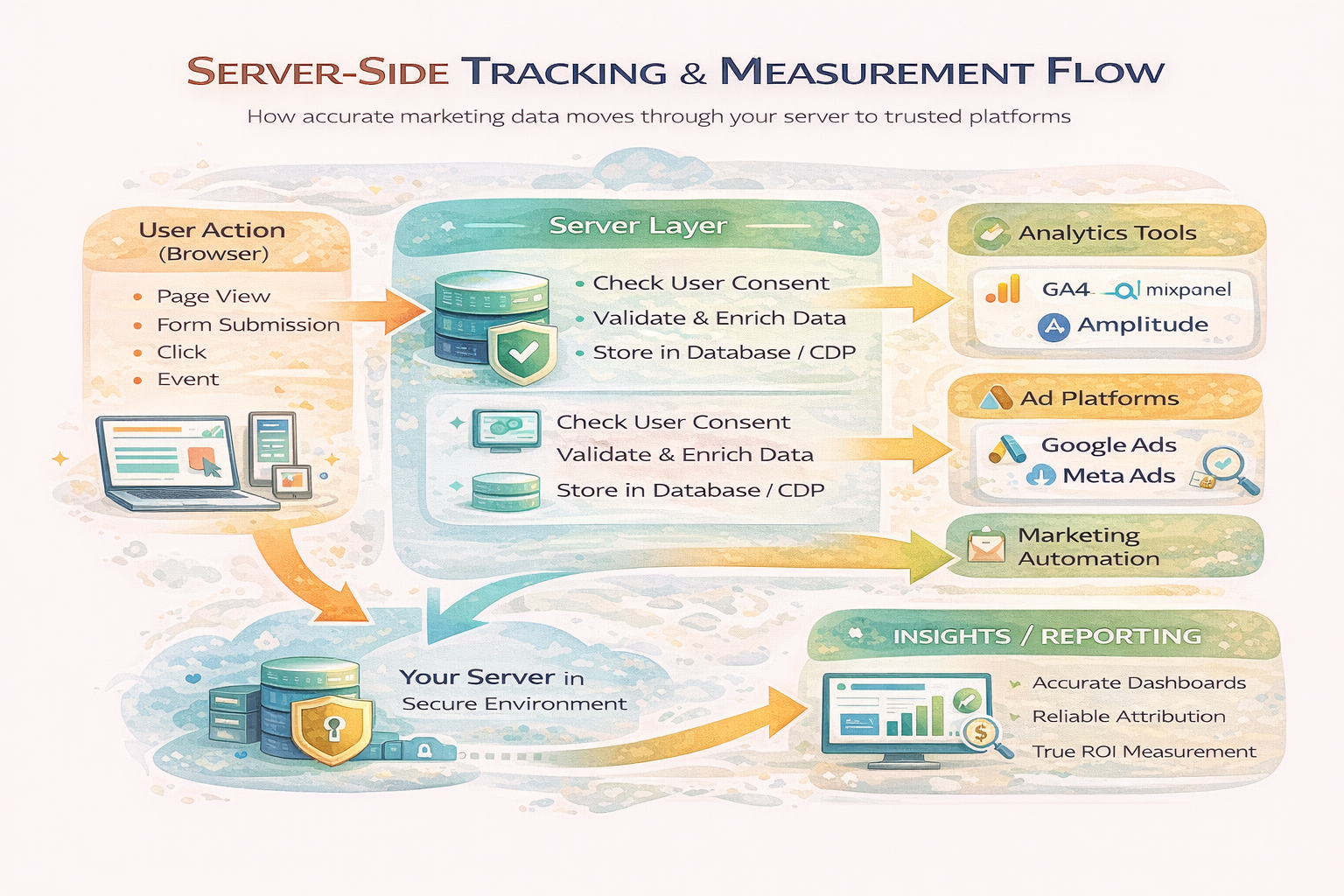
Browser → Your Server → Analytics / Ad Platforms
This gives brands ownership, accuracy, and control over their data.
Why Client-Side Tracking Is Failing
Traditional client-side tracking struggles with:
- Ad blockers blocking scripts
- Browser privacy restrictions (ITP, ETP)
- Cookie consent limitations
- Data loss on slow or failed page loads
- Inconsistent attribution
The result?
Incomplete data, broken funnels, and misleading ROI metrics.
How Server-Side Tracking Fixes This
1. Improved Data Accuracy
Events are sent reliably from your server, not dependent on browser behavior.
2. Better Privacy & Compliance
You control:
- What data is collected
- When it’s sent
- Based on user consent
This aligns perfectly with GDPR, DPDP, and global privacy laws.
3. First-Party Data Ownership
Server-side tracking uses:
- First-party cookies
- Secure user identifiers
- Controlled storage
No dependency on third-party scripts.
4. Cleaner Attribution
With consistent event flow, attribution models become more accurate especially for:
- Conversions
- Paid campaigns
- Multi-touch journeys
Technical Architecture (Simplified)
- User performs an action
- Browser sends event to your server
- Server validates consent & enriches data
- Event is forwarded to analytics, ads, CDP
This architecture enables measurement you can trust.
What Marketers Can Track Server-Side
- Page views & sessions
- Conversions & purchases
- Form submissions
- In-app actions
- Funnel progress
- Revenue events
All without exposing raw data to third parties.
Server-Side Tracking vs Client-Side Tracking
| Client-Side | Server-Side |
|---|---|
| Browser-dependent | Infrastructure-controlled |
| Blockable | Resilient |
| Less secure | More secure |
| Data loss common | Data consistency |
| Platform-owned | Brand-owned |
Why This Is a Niche Marketing Skill
Most marketers:
- Use tools
- Rarely understand how data flows
- Depend on platform defaults
Marketers who understand server-side tracking:
- Speak both marketing and engineering
- Design measurement strategies
- Build privacy-first analytics
- Lead data-driven decisions
This skill sits at the intersection of marketing, data, and privacy.
Who Should Learn This Skill?
- SaaS marketers
- Growth marketers
- Performance marketers
- Product marketers
- Analytics & CRO specialists
Especially in B2B and subscription-based businesses.
The Future of Measurement
As third-party cookies disappear and privacy expectations rise, server-side tracking will become the default not the upgrade.
Brands that adopt it early gain:
- Trust
- Better insights
- Competitive advantage
Final Thought
Marketing decisions are only as good as the data behind them.
Server-side tracking ensures that data is accurate, ethical, and future-proof.
In the next era of digital marketing, measurement itself becomes a strategic advantage.