Marketing automation has transformed the way brands engage customers, but building effective automation is more than just connecting tools. Without a solid Marketing Automation Architecture (MAA), campaigns become fragmented, data is inconsistent, and personalization fails.
Marketing Automation Architecture is the blueprint that ensures your automation is reliable, scalable, and intelligent.
What Is Marketing Automation Architecture?
Marketing Automation Architecture is the structured design of workflows, integrations, and data pipelines that power automated marketing campaigns.
It combines:
- Strategy: What marketing goals are being automated
- Technology: Platforms, APIs, and integrations
- Data: Clean, accurate, and actionable data
- Execution: Timely, personalized campaigns across channels
Simply put: it’s the engine under the hood of automated marketing.
Why Brands Need a Strong Architecture
Without a proper architecture:
- Campaigns break when platforms update
- Customer journeys are inconsistent
- Data mismatches lead to poor attribution
- Personalization is limited
With a well-designed architecture:
- Campaigns scale effortlessly
- Journeys adapt dynamically to user behavior
- Insights are accurate and actionable
- ROI improves
Core Components of Marketing Automation Architecture
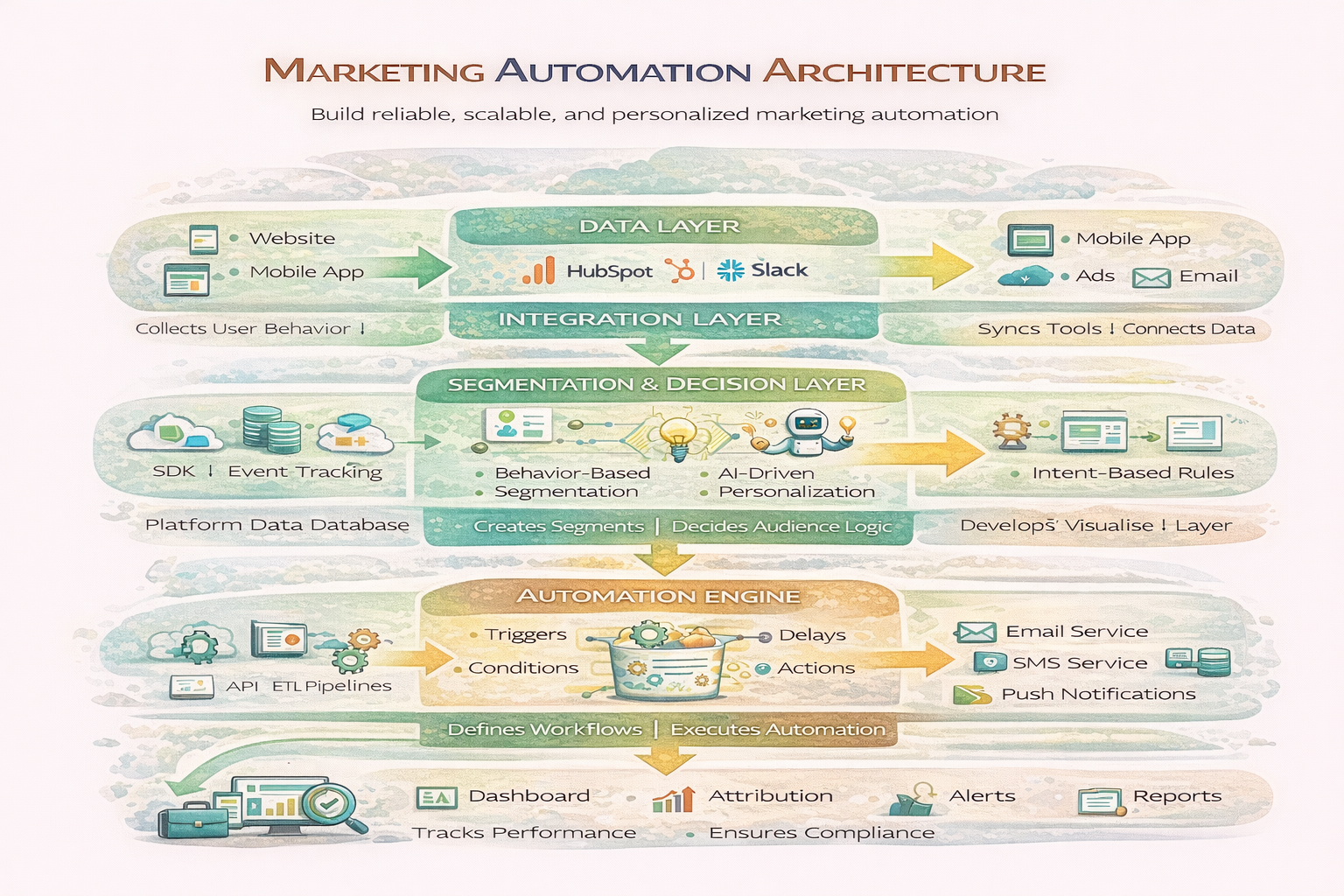
1. Data Layer
- Collects and centralizes user behavior from websites, apps, CRM, and ads
- Ensures consistent identifiers and data quality
- Supports segmentation, personalization, and reporting
2. Integration Layer
- Connects marketing automation tools, CRM, analytics platforms, and ad networks
- Uses APIs, webhooks, and ETL pipelines
- Ensures real-time data flow between systems
3. Automation Engine
- The brain of marketing automation
- Runs workflows based on triggers, conditions, and user behavior
- Supports multi-step campaigns: emails, SMS, push notifications, ads
4. Segmentation & Decision Layer
- Dynamically segments users by behavior, lifecycle, or intent
- Applies rules or AI models to determine campaign flow
- Enables adaptive personalization
5. Execution Layer
- Sends messages via the right channel at the right time
- Supports multi-channel orchestration
- Logs events for reporting and optimization
6. Monitoring & Analytics
- Dashboards track campaign performance, engagement, and conversions
- Alerts detect failures or anomalies in workflows
- Provides feedback loops to improve automation
Marketing Automation Architecture vs Traditional Automation
| Traditional Automation | Modern Automation Architecture |
|---|---|
| Tool-specific workflows | Platform-agnostic pipelines |
| Static rules | Dynamic, behavior-driven flows |
| Limited personalization | Adaptive, real-time personalization |
| Hard to scale | Scalable and maintainable |
| Fragmented reporting | Centralized insights & attribution |
Use Cases of Marketing Automation Architecture
- Lead Nurturing: Automated campaigns that move leads from awareness to conversion
- Lifecycle Marketing: Personalized onboarding, retention, and re-engagement journeys
- Cross-Channel Campaigns: Email, SMS, push notifications, and ads working in harmony
- Behavioral Triggers: Reacting to real-time user actions like cart abandonment or page revisits
Why This Is a Niche Marketing Skill
Marketers with knowledge of Marketing Automation Architecture can:
- Design scalable, future-proof workflows
- Solve cross-platform integration challenges
- Improve personalization and ROI
- Bridge the gap between marketing strategy and tech execution
It’s a skill that sits at the intersection of growth, data, and engineering making it highly valuable.
The Future of Marketing Automation Architecture
- AI-driven adaptive workflows
- Predictive triggers and intent-based personalization
- Real-time cross-channel orchestration
- Privacy-first, consent-aware automation
Brands that master this architecture will automate smarter, not just harder, and scale campaigns with confidence.
Final Thought
Marketing automation is only as good as the architecture behind it.
Marketing Automation Architecture transforms scattered tools and workflows into a smart, scalable, and measurable growth engine empowering marketers to deliver the right message, at the right time, to the right person.