Every visitor that lands on your website is silently telling you something.
Not through forms.
Not through surveys.
But through behavior.
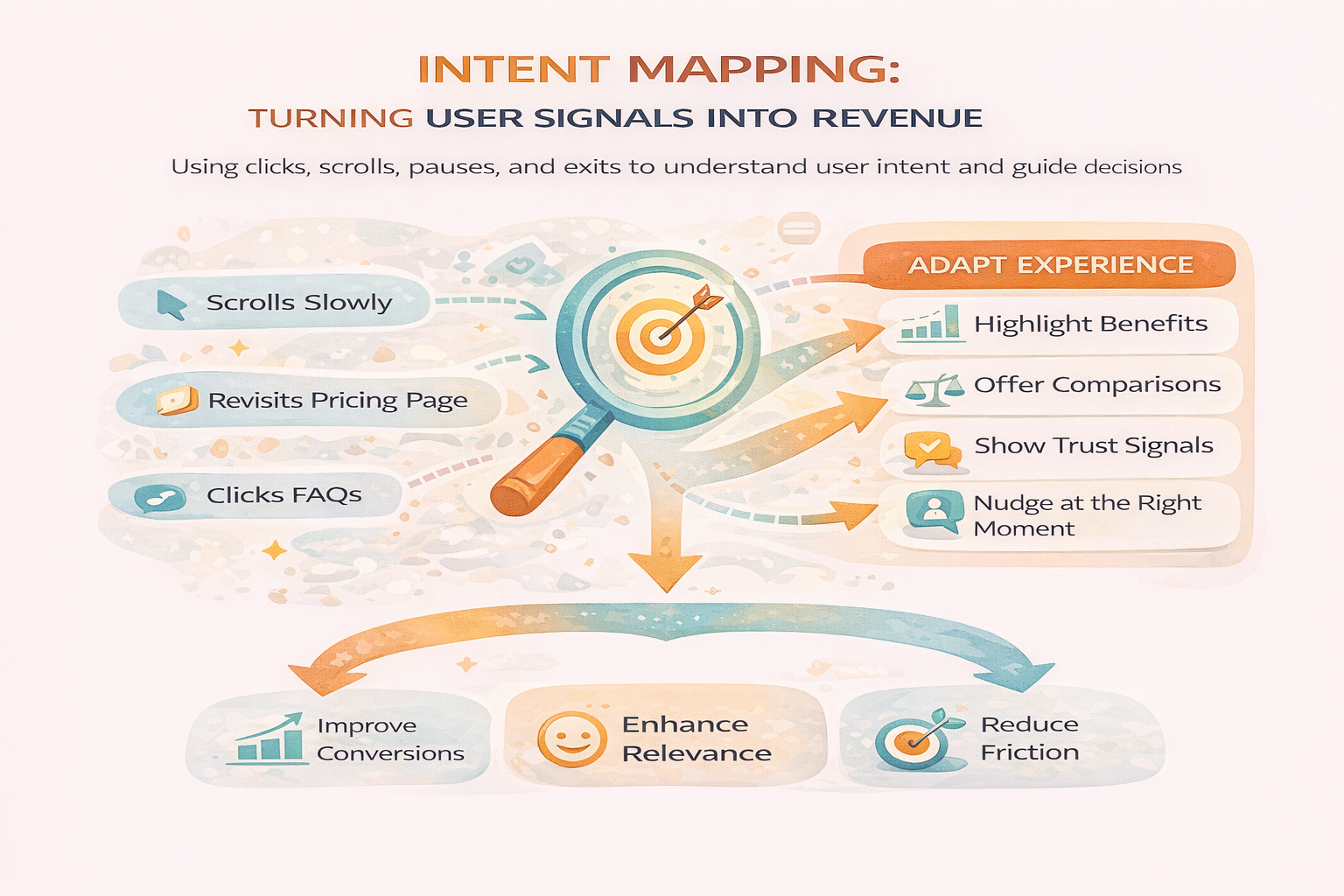
Clicks, scrolls, pauses, exits, revisits these are not random actions. They are signals of intent. Brands that learn to read and respond to these signals don’t just improve engagement they turn intent into revenue.
This is the power of Intent Mapping.
What Is Intent Mapping?
Intent Mapping is the process of:
- Identifying user behavior signals
- Interpreting what those signals mean
- Responding with the right experience in real time
Instead of guessing what users want, intent mapping lets behavior do the talking.
It shifts marketing from assumptions to evidence-based action.
Why Intent Matters More Than Traffic
Traffic tells you how many users arrived.
Intent tells you why they are there.
Two users can land on the same page:
- One is casually browsing
- One is ready to buy
Treating them the same leads to missed opportunities.
Intent mapping ensures:
- Curious users get education
- Hesitant users get reassurance
- Ready users get clear CTAs
Relevance increases. Friction drops. Conversions rise.
Key User Signals That Reveal Intent
Intent mapping focuses on micro-behaviors, such as:
- Scroll depth → Interest level
- Time spent → Evaluation vs skimming
- Page revisits → Comparison or high intent
- Hover behavior → Decision hesitation
- Exit intent → Friction or uncertainty
- Navigation loops → Confusion
Each signal is a clue. Together, they tell a clear story.
From Signals to Meaning
Intent mapping is not about tracking everything it’s about interpreting correctly.
For example:
- Repeated visits to pricing → Purchase consideration
- Long time on FAQs → Objection handling needed
- Sudden exits → Missing clarity or trust
Once intent is identified, the experience can adapt.
How Intent Mapping Turns Into Revenue
Intent mapping enables real-time experience optimization.
Examples:
- Show trust badges when hesitation is detected
- Highlight benefits when users scroll slowly
- Offer comparisons for repeat visitors
- Trigger contextual nudges instead of pop-ups
- Change CTAs based on readiness
Instead of pushing offers, brands guide decisions.
That’s where revenue comes from.
Intent Mapping vs Traditional Segmentation
Traditional segmentation:
- Static
- Demographic-based
- Predefined
Intent mapping:
- Dynamic
- Behavior-driven
- Real-time
Segmentation guesses.
Intent mapping listens.
The Role of Personalization in Intent Mapping
Personalization is how intent mapping becomes actionable.
It allows brands to:
- Adapt content instantly
- Change messaging mid-session
- Personalize journeys without forms
- Optimize continuously
Without personalization, intent mapping stays theoretical.
With it, it becomes a growth engine.
Why Smart Brands Are Investing in Intent Mapping
Because intent mapping:
- Improves conversion rates
- Reduces bounce and drop-offs
- Shortens sales cycles
- Enhances user experience
- Maximizes existing traffic
In a competitive digital world, understanding intent is the real advantage.
The Future: Intent-First Experiences
The future of digital marketing is not more campaigns—it’s intent-first design.
Websites will:
- Predict user needs
- Respond before users ask
- Learn continuously
- Optimize autonomously
Brands that master intent mapping today will lead tomorrow.
Final Thought
Users are already telling you what they want.
The only question is:
Are you listening?
Intent mapping turns silent signals into meaningful action and meaningful action into revenue.