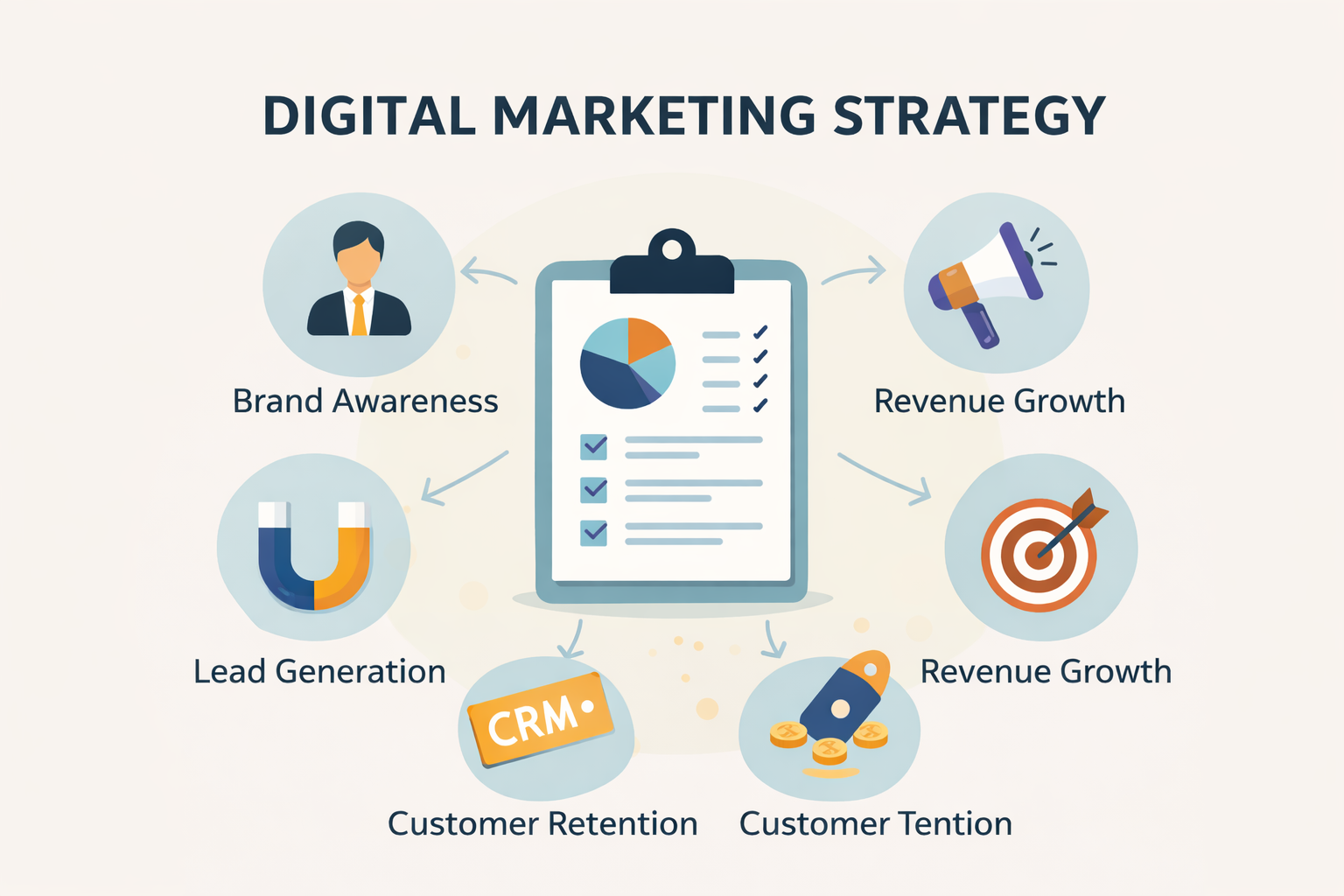
Running digital marketing campaigns without a strategy is like sailing without a compass. Successful digital marketing starts with a clear, goal-oriented strategy that aligns business objectives with customer needs.
A strong digital marketing strategy focuses on:
- Brand awareness
- Lead generation
- Customer acquisition
- Customer retention
- Revenue growth
By mapping each digital channel to a specific goal, businesses can maximize impact and avoid wasted spend.
Customer Journey Mapping in Digital Marketing :
Modern digital marketing is built around the customer journey rather than individual campaigns.
Key Journey Stages:
- Awareness – User discovers your brand
- Consideration – User compares options
- Decision – User converts
- Retention – User returns and engages
- Advocacy – User promotes your brand
Digital marketing tools allow brands to deliver relevant messages at each stage, ensuring a smooth and consistent experience across channels.
Data-Driven Marketing: The Real Advantage :
One of the biggest strengths of digital marketing is data.
Brands can track:
- Traffic sources
- User behavior
- Conversion paths
- Engagement metrics
- Campaign ROI
With these insights, marketers can:
- Optimize campaigns in real time
- Identify high-performing channels
- Reduce acquisition costs
- Improve personalization
Data transforms marketing from guesswork into precision.
The Role of Automation in Digital Marketing :
Automation helps marketers scale without losing quality.
Examples include:
- Automated email workflows
- Retargeting campaigns
- Lead scoring
- Scheduled social media posts
- Behavior-based triggers
Automation saves time, improves consistency, and allows teams to focus on creativity and strategy.
Digital Marketing and Website Optimization :
Driving traffic is only half the battle. Converting traffic is where growth happens.
Optimized websites include:
- Fast loading pages
- Clear CTAs
- Personalized experiences
- Mobile-friendly design
- A/B tested layouts
When digital marketing is combined with website personalization and optimization tools, conversion rates improve dramatically.
Common Digital Marketing Mistakes to Avoid
- Focusing only on traffic, not conversions
- Ignoring mobile users
- Not tracking performance
- Running campaigns without personalization
- Using the same message for all audiences
Avoiding these mistakes helps brands build sustainable growth.
Digital Marketing Trends to Watch
The future of digital marketing is shaped by:
- AI-powered personalization
- Voice search optimization
- Short-form video content
- Influencer marketing
- First-party data strategies
- Omnichannel customer experiences
Brands that adapt early stay ahead of the competition.
Conclusion: Digital Marketing Is a Continuous Process
Digital marketing is not a one time activity it is a continuous cycle of testing, learning, and optimization. Businesses that embrace innovation, data, and personalization will build stronger relationships with their customers and achieve long-term success.
The most successful brands do not just market digitally they think digitally.