For years, marketers have relied on the traditional funnel:
Awareness → Consideration → Conversion
It looks clean.
It feels logical.
And it’s completely outdated.
Today’s users don’t move in straight lines. They explore, compare, leave, return, hesitate, and switch devices. Treating this behavior as linear leads to missed opportunities and lost conversions.
Welcome to the era of behavioral funnels.
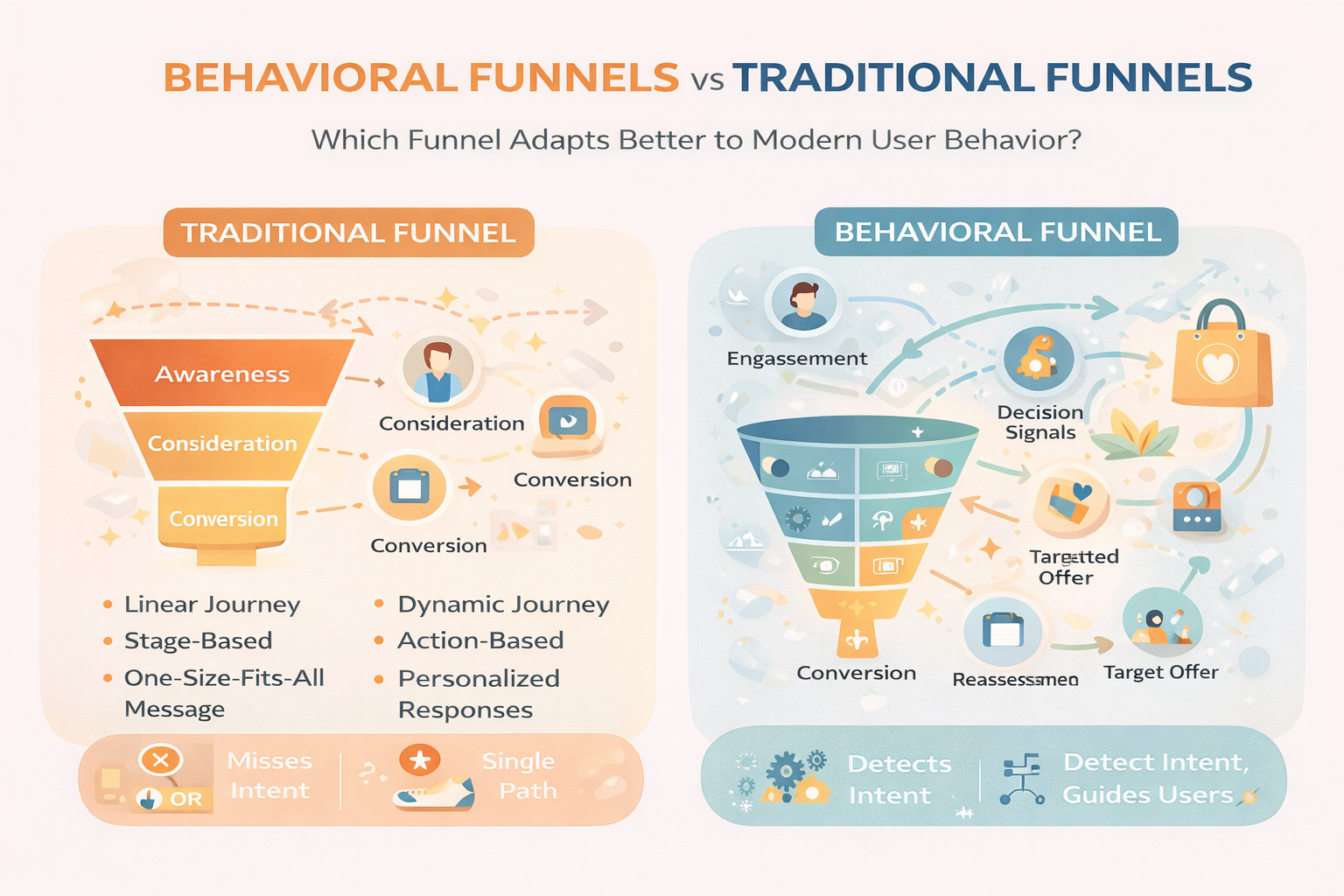
What Is a Traditional Funnel?
A traditional funnel assumes that:
- Users move step by step
- Everyone follows the same journey
- One message fits each stage
- Progress happens once
Traditional funnels focus on where users are, not what they are doing.
This model worked when digital journeys were simpler. Today, it struggles to reflect real user behavior.
What Is a Behavioral Funnel?
A behavioral funnel is non-linear, adaptive, and intent-driven.
Instead of fixed stages, it responds to:
- User actions
- Engagement patterns
- Decision signals
- Contextual behavior
In a behavioral funnel:
- Users can jump between stages
- The experience adapts in real time
- Messaging changes based on intent
- Conversion paths are dynamic
The funnel follows the user not the other way around.
Why Traditional Funnels Fall Short Today
Modern users:
- Research across devices
- Compare multiple brands
- Return multiple times before converting
- Expect personalized experiences
Traditional funnels can’t:
- Detect hesitation
- React to intent
- Adapt messaging instantly
- Handle looping journeys
This leads to:
- High bounce rates
- Drop-offs
- Missed conversions
How Behavioral Funnels Work in Practice
Behavioral funnels respond to signals, not stages.
Examples:
- A user revisiting pricing pages → high intent
- A user scrolling slowly → evaluating
- A user exiting suddenly → friction
- A user clicking FAQs → objections
Each signal triggers a contextual response:
- Trust messages
- Personalized CTAs
- Helpful nudges
- Targeted offers
The experience evolves with the user.
Behavioral Funnels Are Experience-Driven
Instead of pushing users forward, behavioral funnels:
- Reduce friction
- Guide decisions
- Answer questions
- Build confidence
This creates a natural flow that feels human not forced.
Users don’t feel marketed to.
They feel understood.
Why Behavioral Funnels Convert Better
Behavioral funnels:
- Adapt in real time
- Respond to micro-moments
- Personalize continuously
- Shorten decision cycles
- Increase engagement
They turn uncertainty into clarity and curiosity into action.
The Role of Personalization in Behavioral Funnels
Personalization is the engine behind behavioral funnels.
It enables:
- Real-time segmentation
- Intent detection
- Dynamic messaging
- Continuous optimization
Without personalization, funnels remain static.
With it, they become intelligent.
Traditional Funnel vs Behavioral Funnel (Quick Comparison)
| Traditional Funnel | Behavioral Funnel |
|---|---|
| Linear journey | Dynamic journey |
| Stage-based | Action-based |
| Same message per stage | Personalized responses |
| One-time conversion | Ongoing optimization |
| Predictable | Adaptive |
The Future: Funnels That Learn
The future of marketing isn’t funnels that push users it’s funnels that learn from them.
Behavioral funnels:
- Evolve with every interaction
- Improve with data
- Optimize automatically
- Scale effortlessly
They don’t replace strategy they enhance it.
Final Thought
Users don’t follow funnels.
They follow curiosity, doubt, and intent.
Traditional funnels assume control.
Behavioral funnels embrace reality.
In a world where user journeys are unpredictable, the smartest funnels are the ones that adapt.